
I had the honour of presenting a Jewish assembly at a school attended by a number of our members on Armistice Day. I took with me the ‘British Jewry Book of Honour.’ It’s a mighty tome, thicker than the breadth of my hand. Inside, after several pages of ‘Letters from Distinguished Men’, including Minister of War Winston Churchill, comes page after page after page of the over 60,000 Jewish members of the Armed Services who fought in what was then called The Great War (who, after all, could be so stupid to think humanity would do it all again in just a few decades?). There’s a full separate list of the 2,324 who gave their lives and special mention is given to the 1,538 who “obtained honours,” including the “Five Jewish soldiers who won the highest honour it is possible to obtain in our country, namely the Victoria Cross.”
Of course, recording names and stories is vitally important. But it was the other sentiment behind the book that struck me so forcibly this year.
“Nothing,” the preface states in the formal language of the early 1920s, “is more remarkable, in the whole course of their long history, than the way in which in the British Empire, wherever they were living, the sons of Israel came forward and bore their part, thinking only of the great cause at stake. In doing this they asserted before the eyes of all the world all that is great and permanent in the idea of nationality and showed, once more, that neither time, nor exile, nor oppression, can extinguish the sacred spark.
“British Jews have vindicated, once and for all time, their right to British citizenship. They have proved in an unmistakable manner that they are part and parcel of the Empire. Great Britain was the first country in the world completely to emancipate the Jews. This was in 1854. The opportunity to justify that emancipation did not come for sixty years, but when it did come - in August 1914 - the opportunity was seized with a spontaneity and enthusiasm that surprised even those who knew the loyalty of the British Jews.”
The British Jewry Book of Honour is a book that is intended to disabuse the notion haters of Jews like to propagate/suggest/dog whistle - that we are not, really, British. The challenge remains. And not just for Jews.
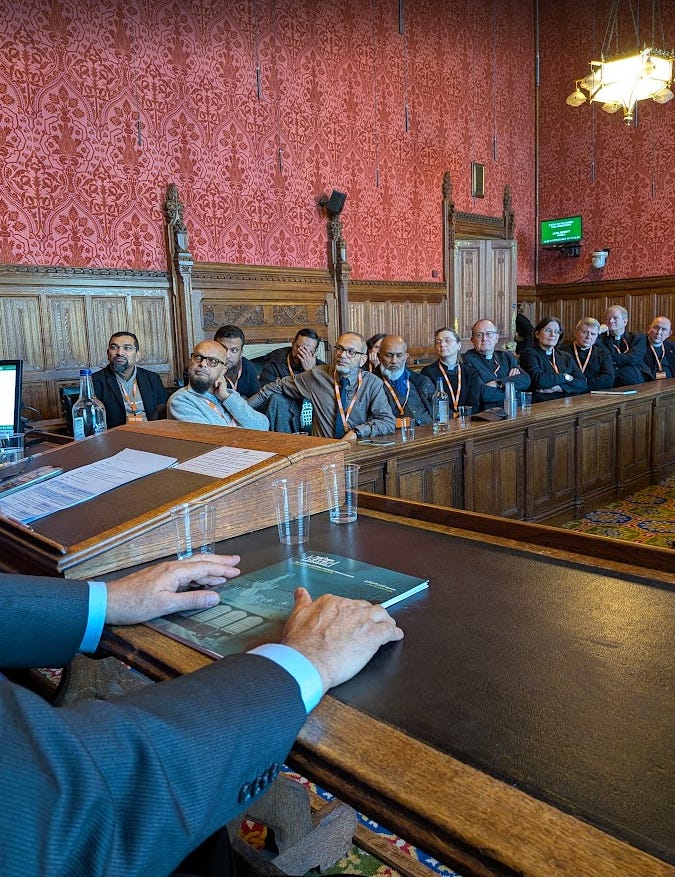
It’s been Interfaith Week, I’ve been at a meeting at the Palace of Westminster with Muslim members of our constituency who recalled being told to “Go back where you came from.” They too, were born here. Muslims too serve this country. I listened on the morning of the 11th of the 11th to a radio interview with a Sikh Major General recounting the lost names of soldiers from India – then part of the British Empire – now rediscovered and honoured.
The point is that a hyphenated identity (Jewish-British, Muslim-British, British-Indian) is a central part of the patchwork of what it means to be British. Indeed, we are all hyphenated one way or another. The Royal Family changed their name to Windsor from Saxe-Coburg und Gotha. Even the very notion of ‘Anglo-Saxon’ owes its origin to Saxony … not part of the British Isles.
We are who we are because of our ability to celebrate difference, Jewish difference and other differences. We should be proud of our contribution and welcome the contribution of others.
Shabbat Shalom


 Posts

