A perk of the job.
I was invited to perform a wedding, right back in the early days of the Hebrew Year just concluded, close to the border between Spain and France.
“We should go,” my wife suggested, “to Portbou” – the first town inside Spain, “and visit the sculpture Passages, Homage to Walter Benjamin, by the Israeli artist, Dani Karavan.”
So we went.
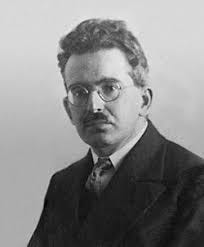
Walter Benjamin first – Benjamin was one of the great German-born Jewish intellectuals of the early 20th Century. Born in Berlin in 1892, he died in Portbou – I’ll come back to that. He was close with Hannah Arendt, Gershom Scholem, Theodor Adorno – that crowd. The Nazis hated him, not just for being Jewish – bad enough – but for thinking the way that he thought – he was a roving intellectual, avant-garde, Marxist-ish, not willing to sign up to anyone’s gang and certainly appalled by rise of Nazism.
Benjamin fled to France and got a visa to America. When the Nazis invaded France he fled again, towards Spain, in the hope of getting from there, to the States.
He crossed the border into Portbou on the 25th September 1940 but the Spanish – ostensibly neutral – demanded he be returned to Germany. Benjamin, expecting he would be handed over to the Nazis, took an overdose of morphine tablets, died, and was buried – Hannah Arendt would later say, “like a dog” – in an unmarked grave in Portbou’s municipal cemetery on a cliffside just outside town.
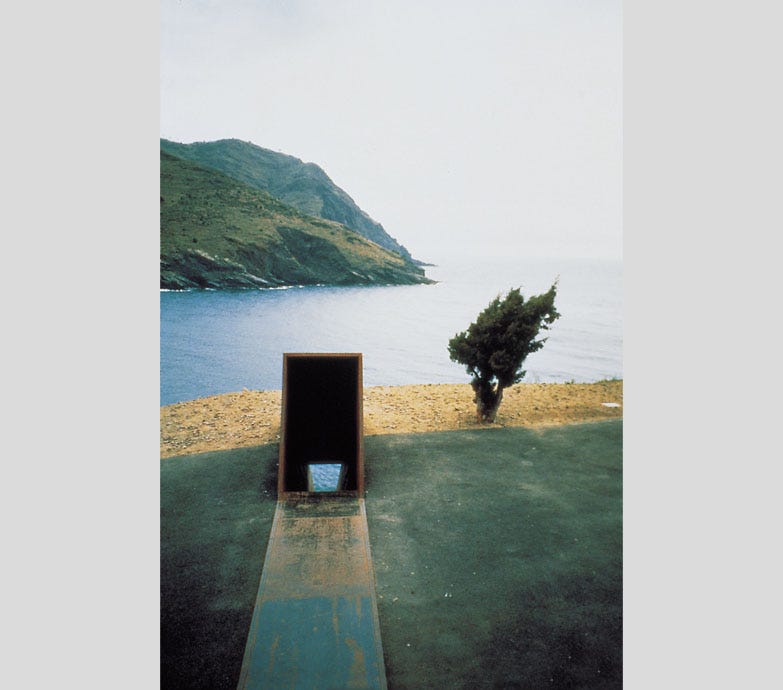
In 1994, Dani Karavan completed his memorial to Benjamin, Passages at the gates to the cemetery. And this is what my wife and I went to see in October last year.
Here’s a photo
Here’s another.
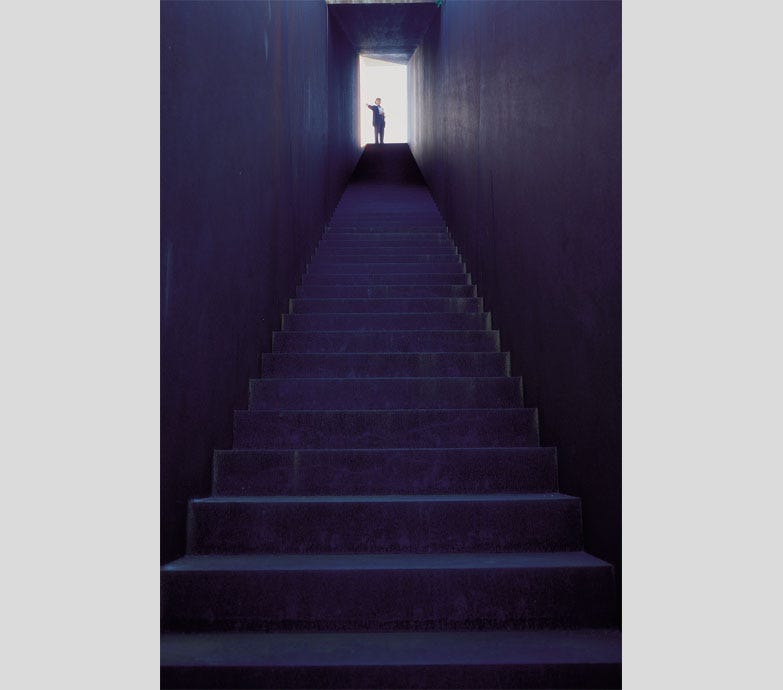
Doesn’t look like much, does it? I’ll get back to that.
The work Benjamin is most famous for is The Role of Art in the Age of Mechanical Reproduction. He wrote it in 1935, and I think it’s the best thing I’ve read this year about Artificial Intelligence. 1935. It’s a critique of modernity and technology – it’s about what happens when we mass-produce stuff in general and images in particular.
Benjamin is interested in cameras – the transformative technology of his day. He charts the way art, in an age of photography, stops being something only a handful of people might ever see on a wall and can become an image to be reproduced and shared with millions – it feels like he’s predicted Instagram and all the rest of it. His particular interest is in the difference between the art – the thing itself - and the mass reproduced version of the thing.
And the term he uses, to grade this difference, is “aura.”
The aura of a thing is the real quality of a thing. It’s the artistic impact of the art itself. To stand before a painting is to appreciate the aura of a painting. A photo of a painting has less aura. Goodness knows what he would have thought of selfies, filters and AI versions of how we might have looked in the 1980s. But writing about mechanical reproduction in the 1930s he writes about the loss of aura – the thing that gets lost when mechanical reproduction fails, as it will always fail, to reproduce the essence of the art itself.
Something, certainly, is lost in the photographs of Dani Karavan’s memorial to Walter Benjamin. I know the photos don’t look like much, but, in person, the memorial is incredibly moving.
The reality, the unique, unrepeatable, reality of going to visit Karavan’s memorial is that you climb into it – you climb down a long flight of clanking metal stairs through a dark and slightly rusting iron corridor-like tunnel, down towards a viewpoint, shaped like an open doorway, overlooking the Portbou bay. As you look at the sea framed by darkness, the waves glisten like silver and the sky seems a particularly bright shade of blue, and birds, soar like, Kchalom Yauf – like a dream in flight as they soar through the viewpoint over the bay. And the whole thing made me want to cry for the sheer waste of remarkable life – Benjamin’s life, and every life brutally brought short then, and since.
Karavan’s memorial to Walter Benjamin, unmistakably, brilliantly and clearly completely deliberately has aura. And the photos, unmistakably brilliantly and completely deliberately don’t.
And that’s the thing about AI – it reproduces, without the same aura, the real thing. It’s impressive. It’s mightily impressive, but it’s a replication. It makes things, graphic images, undergraduate essays even mathematical proofs, without aura.
I want to sensitize us to the threat of losing an appreciation for aura.
I want, at this most holy time of this most holy day, to make the case for pursuing aura. I mean, if you are trying to work out how to fold proteins, or provide a proof of the Sendov conjecture or cure cancer – you go right ahead and keep tapping those prompts into those remarkable technological portals.
But if you are trying to live well, or be happy, or be immersed in the essence of what it means to be human – pursue things of aura.
Visit art installations on clifftops that you must clamber inside to ‘get.’
Visit any kind of art.
If you want music, listen to the real sound of real instruments and real voices sung by real people.
If you want friendship or a sense of human connection, seek out real people, not avatars, not airbrushed, photoshopped, AI generated slop that scrolls by as we swipe.
Treat this universe, and everything in it, as an invitation to experience its aura – what Benjamin called, “the authenticity of a thing.”
Spend time, by engaging with time passing – maybe even in a Synagogue, on a day like Yom Kippur, watching the way the day turns to night behind the real windows – the ones on that [R] side of the building. Rather than wishing to be where the light always remains perfectly uniformly bright – on this [L] side of the building – though I love those [L] windows. Even though it’s getting a bit gloomy over there [R]. Even if you feel there might be some kind of higher marginal propensity to gain utility if we were to rig up an AI assisted lighting system that measured the luminosity of the slowly dimming day and topped it up with a slowly brightening halogen glow, I wouldn’t want it. I want to experience the aura of the setting sun Ki Fanah HaYom – for the day is indeed turning.
This pursuit of aura is, I think, a deeply Jewish idea.
Shabbat, I think, is the invitation to appreciate aura – connecting to our lives unmediated by mechanical reproductive forces coming along and reproducing, making efficient and rubbing out the edges of the reality of our lives.
Kashrut, I think, is an invitation to appreciate the aura of the food we eat – or don’t eat; beef that comes from cows that chew the cud and produce milk for their calves that should not be drunk in the same meal in which you eat the meat of the adult. Milk doesn’t come from supermarkets or delivery vans. Vegetables grow from the earth and need a different blessing than the fruit of the trees. Sorry for mentioning food at a time like this.
It’s an honour to have friends of our community joining us on the stream – you are very welcome and we’re lifted by your presence. But I know and I know you know, that it’s not quite the same – the stream doesn’t offer the same aura as being in a room with humans. It’s not trying to match this experience. There’s something about jostling up next to other real human beings with their own real hopes and pains and delights and frustrations that allows us to define our own high moments and low moments in community. Hang on to that in this new world of increasing virtual possibility. Don’t give up on that in this new world of electronic wisdom available at the tap of a button.
I know the LLMs are getting really good at offering counselling – lists of does and don’ts to escort us through our darker journeys, and they do it so effortlessly and politely – is there anything else I can do for you today? But don’t lose site of the importance of aura.
I know there is something seductive about AI. But we’ve had wise Jewish voices telling us not to be seduced into attributing too much power to things artificial since long before even Walter Benjamin’s 1935 essay. This comes from Psalm 115:5
פֶּה לָהֶם וְלֹא יְדַבֵּרוּ עֵינַיִם לָהֶם וְלֹא יִרְאוּ
They have mouths, but they don’t speak, they have eyes, but they don’t see.
There is a difference between that which looks godly and God – there are and there have always been idols that glitter and are not truly gold. The Psalmist knew that, Shakespeare too. It helps to spend time with ancient sources of knowledge. It will help if we are hang onto the skills that allow us to differentiate between the sacred and the profane.
We’re going to have place increasing value on the real – if we want to value the very things that make us human. We’re going to have to spend time and even money on the pursuit of aura. Even if the LLMs are cheaper at the moment we tap away. I like that line – that if you aren’t paying for some technological wizardry, you aren’t a client, you are the product. We’re going to have to invest in real artists and real musicians, real foods, real synagogues, real time and real human beings. Because unless we sharpen our sensibilities and prioritise our values, we’ll find those things will crumble away and we’ll be left with … well less aura.
So here we are.
Having spent a day together, for real. Feeling hungry, for real. In a room of real people. With real voices singing real prayers. And we have this last hour to fix our Kavvanot, our intentions for the year. My invitation is to spend more time pursuing things that are real, my invitation is to spend more time pursuing the aura of real art in this most beautiful world.
Chatimah Tovah,
May it come to us all for good.


 Posts
Posts


No comments:
Post a Comment